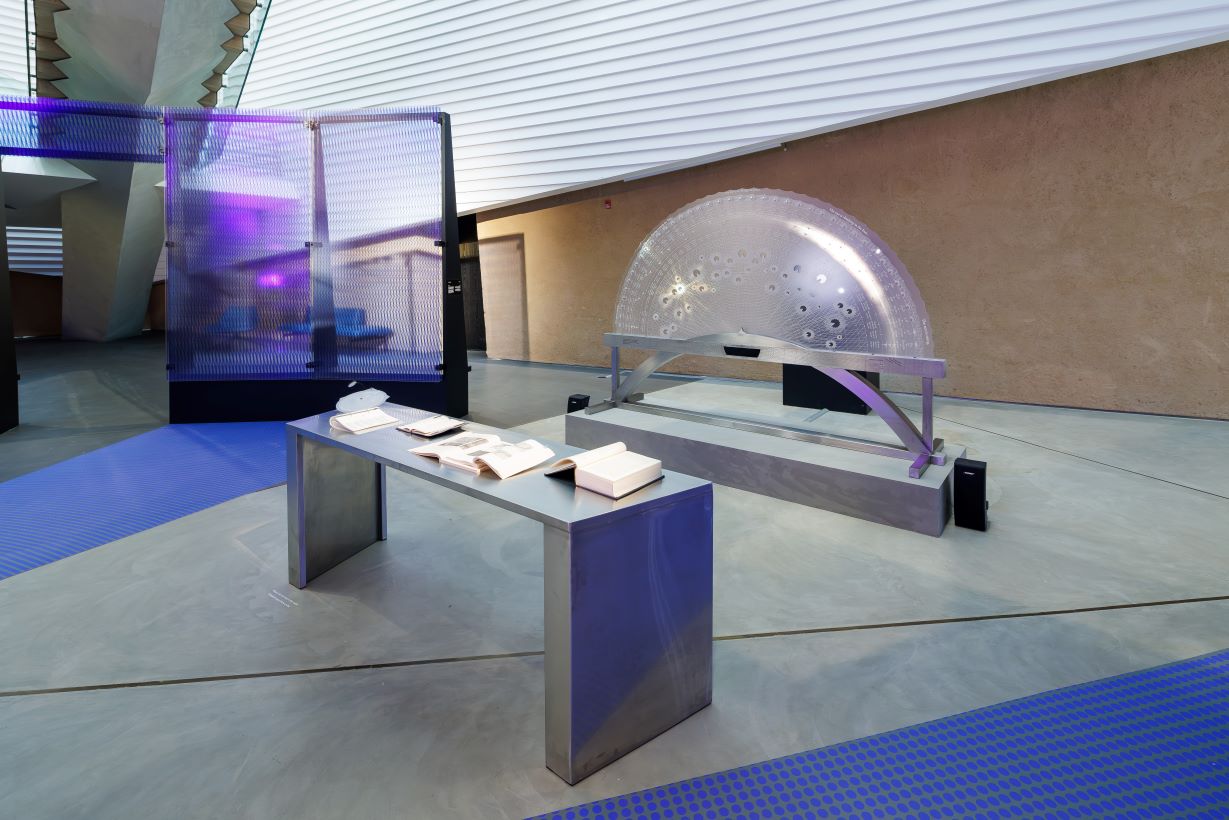
At the intersection of historical cosmology, linguistic nuance, and contemporary technology, Kuwaiti artist Badriyah Al-Salem invites us to reorient ourselves through the movements of the sky. Participating in CONTINUUM ’26 following her journey through Diriyah Art Futures’ (DAF) year-long Emerging New Media Artists Programme, Al-Salem debuts Names of the Sun—a striking synthesis of scientific diagram, instrument, and poetic inquiry.
Tracing 41 historical Arabic names for the sun as it traverses from east to west, the artwork draws on classical astronomical toolmaking to map space and time through celestial motion, probing our seasonal rhythms and our elemental relationship with daylight.
Here, Badriyah speaks with Khaleejesque about her creative foundations, the linguistic and celestial research behind her new work, her transformative experience with DAF, and what it means to present in Saudi Arabia amid a vibrant, region-defining cultural movement.
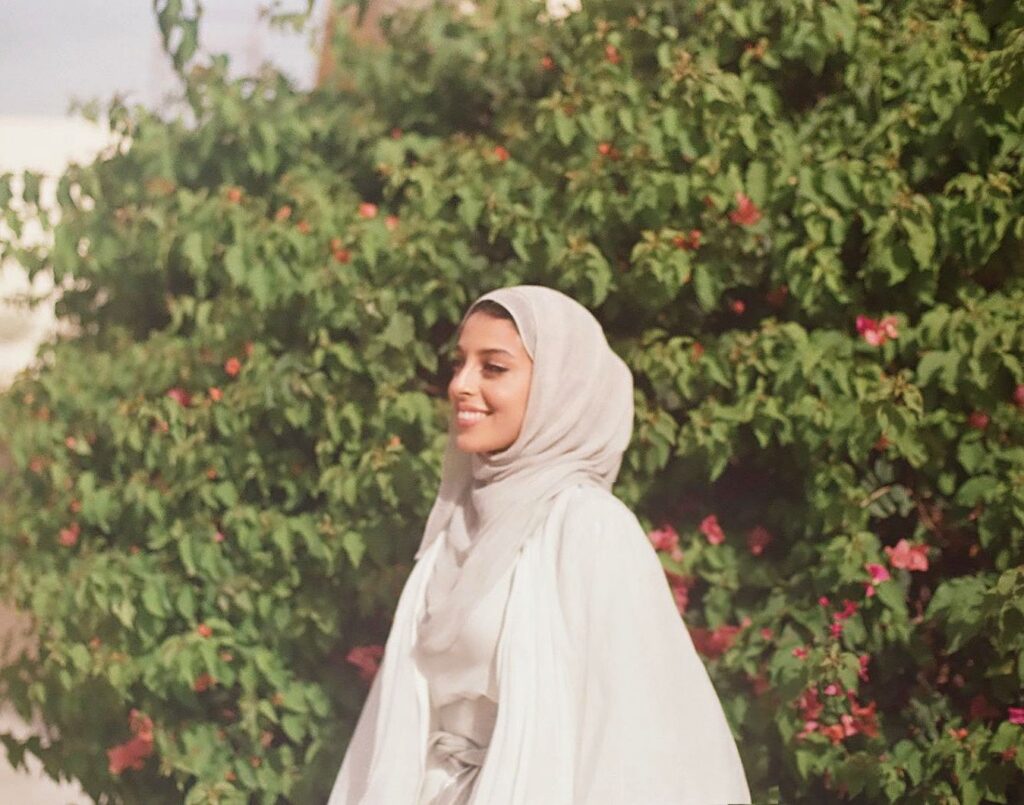
Khaleejesque (K.M.): To start, can you share a bit about your journey into new media art? How did you arrive at combining heritage, language, and celestial observation with contemporary digital technology?
Badriyah Al-Salem (B.A.): It began with a love for heritage and, through field research, a growing understanding of how Arab Bedouins used the stars to navigate and tell time. After spending so much time beneath the desert sky and practising those traditional methods, I became aware of both the distance and the connection between life in the desert and life in the city.
I felt both a huge gap and an interesting parallel. Comparing navigation using Bedouin methods with navigation using Google Maps revealed to me that these two things aren’t separate at all. The movements of the sun, moon, and stars across the sky were the precursors to our modern navigational and time-telling technologies. The Arab Bedouin methods of navigating and telling time using the sky are more modern, more complex, and more advanced than the tools we use today. So, it naturally felt like a responsibility to connect this knowledge with contemporary digital technology while allowing the richness of our tradition to speak for itself.
As the sky became more legible to me, I felt increasingly proud that our heritage could also be part of how we live every day. This heritage deserved to be brought out of history, dusted off, and allowed to develop, breathe, evolve, and find its place in a changing world. My heritage deserves that opportunity. So, I turned to new media art instead of more traditional creative methods.
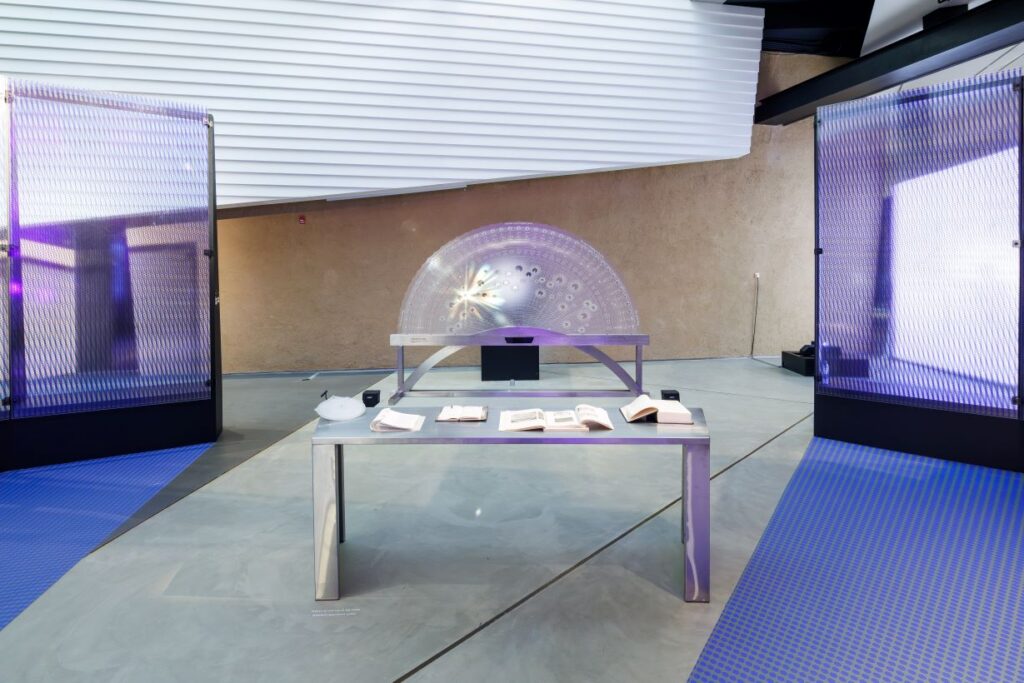
(K.M.): In Names of the Sun, you bring together 41 historical Arabic names for the sun, organizing them according to its path across the sky from east to west. What initially drew you to this rich vocabulary, and how did you approach researching these names?
(B.A.): That rich vocabulary was what I had to depend on as I was learning how to tell time and navigate. Arabs used poetry and descriptive prose to preserve and perpetuate knowledge. What’s seen today as romantic portrayal or surface-level description was actually deep, scientific, quantifiable data, and the survival of the people of the desert depended on it. The language developed and became richly textured and multidimensional to match the depth of their environmental knowledge.
What seems like a description of a star, a cloud, or a pattern in the sand is actually a record of time, space, direction, or information used for tracking. So, something as simple as a descriptive name for the sun—the same sun we see every day, as routine and mundane as it may seem—turns out to hold incredible depth and dimension. The descriptions reflected the lived realities of ordinary people navigating and surviving in the desert.
My approach was to research medieval dictionaries and kutub al-anwāʾ, which describe the environment, and begin compiling these words. The actual database was built from my own understanding. I took each word, read it in context, and tried to imagine what it could mean: sometimes stretching its meaning through my own imagination, sometimes finding medieval literature that explained it, and sometimes finding words so closely tied to human experience that they explained themselves.
That computational process was then developed into a master’s thesis at Columbia University, where I spent a year developing the theory behind it, trying to honour both the past and the future of this work. That’s where the earliest prototypes of Names of the Sun emerged.
(K.M.): Spending a year alongside a cohort of regional and international new media artists often sparks fresh perspectives. How did being in that creative dialogue at DAF influence your approach to technology and storytelling?
(B.A.): It was wonderful to be in such a varied group of artists who were generous with their knowledge, their methods, and their critiques, and just as open to receiving feedback in return. A valuable challenge in my own work was presenting the complexity of the Arabic language and its poetry to colleagues from all over the world.
It forced me to imagine language in completely new ways. How do you explain the texture, the fluidity, the sheer beauty of one language through a different one? So much can live in the sound of a single word: what it borrows from, what it assumes you already know. None of this survives a direct translation. Working through that challenge alongside those talented people pushed me to find new ways to express these nuances.
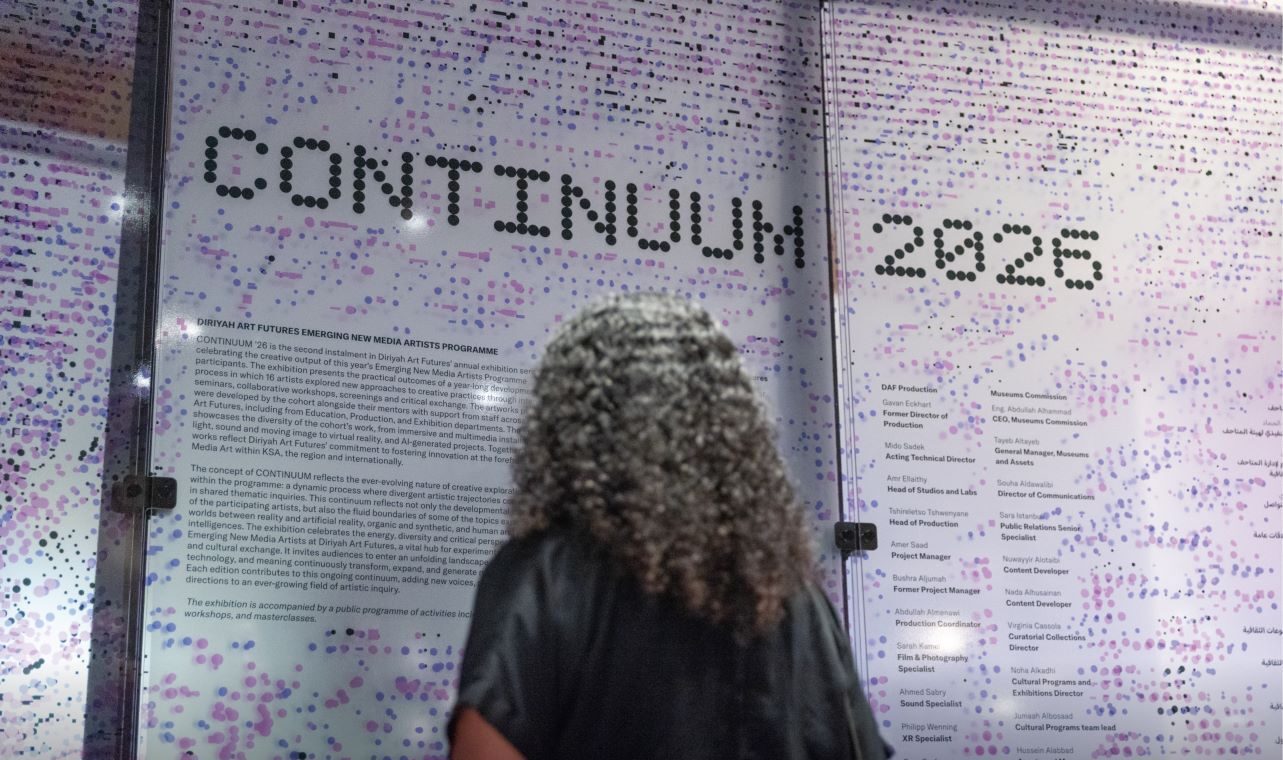
(K.M.): Exhibiting Names of the Sun at CONTINUUM ’26 places your work at the heart of Saudi Arabia’s expanding art ecosystem. As a Kuwaiti artist, how do you view this moment of intense cultural growth and experimentation taking place across the Kingdom and the wider GCC?
(B.A.): I feel so blessed to be honouring, in my own humble way, the forms of knowledge that come from living in the desert and by the sea, and to be able to bring that knowledge into a cultural scene that’s booming right now. It is a wonderful time for medieval Arabic sciences and arts to flourish and play their role in international academic, artistic, and cultural conversations.
(K.M.): New media art in the region is increasingly bridging regional heritage with forward-looking technologies. Where do you see the conversation around Arab digital art heading in the coming years?
(B.A.):: What’s happening in the region right now is inspiring. Institutions, programmes, festivals, biennials, and triennials are creating more space for this work. While it is exciting to watch these rooms being built, I think the natural next chapter is to fill them with our own language.
I would like to see a critical vocabulary that emerges from our own experiences and histories, rather than relying entirely on frameworks developed elsewhere. That also means examining the tools we use, their benefits and limitations, and their hidden implications, so that we can decide for ourselves how they should be built and ultimately build our own.